Why This Comparison Matters Now
The global marketing automation market reached $6.65 billion in 2024 and will hit $15.58 billion by 2030, growing at 15.3% CAGR. Companies see an average return of $5.44 for every $1 spent on automation. Small businesses see up to a 25% ROI lift after adopting these tools.
Yet 47% of marketers pick a platform based on marketing pages instead of hands-on comparison. That is expensive.
This post is the hands-on version. I use both tools in production. Here is where each one wins and where each one falls apart.
Chapter 1: The Short Answer
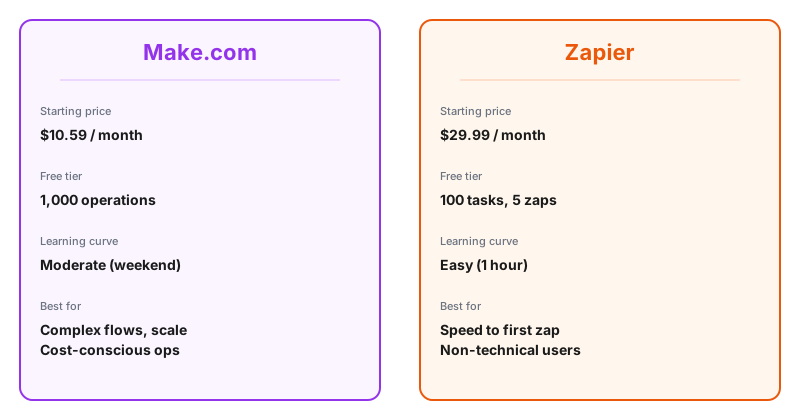
Zapier wins for speed and ease. If a non-technical user wants automation running today, Zapier is the pick.
Make.com wins for depth and cost. If a workflow needs conditional logic, loops, or hundreds of runs a month, Make wins on both features and price.
If you already know that answer fits your situation, skip to Chapter 6 for the pricing math. Otherwise read on.
Chapter 2: Ease of Use
Zapier looks like an email flow. Trigger, then action, then done.
Make looks like a mind map. Modules connect with lines. Data flows through visible bubbles you can inspect at each step.
For a first-time user building a Slack notification when a form fills, Zapier takes 4 minutes. Make takes 12.
For a fifth workflow that includes a filter, an iterator, and two conditional branches, Zapier requires paid tier features and gets clunky. Make handles it in one canvas that stays readable.
Marketing automation users report up to a 451% increase in qualified leads. But the increase only appears when the automation actually runs reliably. Both platforms deliver that reliability. The difference shows up in what a solo operator can build before hitting the platform's ceiling.
Chapter 3: Pricing Reality
Zapier prices per task. Every action module firing counts as a task.
Make prices per operation. Every step within a scenario counts as an operation.
| Tier | Zapier | Make.com |
|---|---|---|
| Free | 100 tasks/month, 5 zaps, no premium apps | 1,000 operations/month, unlimited scenarios |
| Entry paid | $29.99/mo, 750 tasks, multi-step | $10.59/mo, 10,000 operations |
| Mid-tier | $73.50/mo, 2,000 tasks | $18.82/mo, 10,000 operations, faster runs |
| Standard business | $103.50/mo, unlimited premium | $34.12/mo, 10,000 operations, advanced features |
Numbers as of September 2026. Verify on each site before committing.
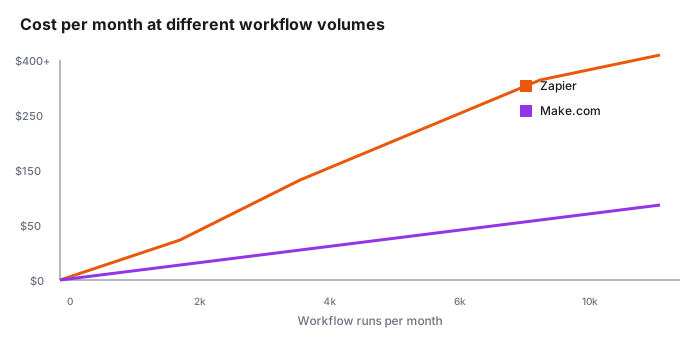
For a small business running 20 workflows with a few thousand runs per month, Make costs about a third of what Zapier does.
Chapter 4: Where Zapier Wins
More app integrations. Zapier lists over 7,000 apps. Make lists around 2,000. If your stack includes a niche tool, Zapier probably supports it while Make requires a webhook workaround.
Faster to build simple workflows. A three-step "when this, do that" workflow lives in Zapier in under 5 minutes. The visual builder rewards linear thinking.
Better documentation. Zapier has been around longer, has more community content, and every common tutorial exists in three formats.
Cleaner error notifications. When a Zap breaks, the email tells you which step and what happened. Make sends an error notification that requires digging into the scenario to interpret.
Chapter 5: Where Make Wins
Real conditional logic. Make lets you branch a scenario based on any field with visual routers. Zapier has paths, but they cost extra and require the Pro tier.
Loops without paying more. Iterators are native to Make. In Zapier, looping through an array requires Code steps or third-party helpers.
Better data manipulation. Make gives you visible bundles of data you can transform in place. Zapier hides most transformations behind Formatter steps that cost tasks.
Cheaper at scale. A workflow with 15 steps consuming 10,000 operations a month is one price on Make and multiples of that on Zapier.
Chapter 6: The Break-Even Calculator
Rough math based on real workflow patterns.
Zapier task cost at the $73.50/mo tier: about $0.037 per task.
Make operation cost at the $18.82/mo tier: about $0.0019 per operation.
A workflow with 5 steps that runs 400 times a month uses 2,000 Zapier tasks. That is $74/mo of consumption on Zapier and 2,000 operations on Make, which fits inside the $10.59/mo tier.
Same workflow, seven times the cost on Zapier.
Chapter 7: The Use Cases Where Each Tool Shines
Zapier is the pick for:
A solo founder connecting Typeform to Slack and Google Sheets. Speed matters more than flexibility.
A sales team that needs Salesforce, HubSpot, or Outreach automation with heavy premium integrations.
A non-technical marketing manager who has to launch this week without training.
Make is the pick for:
An operator running dozens of workflows across a client base. Cost per run compounds.
Any workflow with branching logic, loops, or complex data transformations.
Backend workflows that involve webhooks, REST APIs, or custom code steps.
Ecommerce order processing where a single order triggers a chain of updates across shipping, inventory, and email.
Chapter 8: The Learning Curve
Zapier is learnable in an hour. Someone with no technical background can build a working automation in one afternoon.
Make requires about a weekend to feel comfortable. The visual builder makes intuitive sense once you accept that every module is a bubble that transforms data.
For a small business owner deciding between the two, the trade-off is one afternoon of learning against 60-75% of monthly automation cost.
Only 9% of marketers run fully automated customer journeys. 59% still use partial automation. Most of that gap comes from platform-choice paralysis or hitting a ceiling on the current tool. Choosing the right platform on day one prevents a costly rebuild in year two.
Chapter 9: What Neither Tool Handles Well
Both platforms struggle with high-volume, real-time data streaming. When a workflow needs to process 100,000 records in under an hour, both tools slow down or bill unreasonably.
For that scale, custom Python scripts on a scheduled cloud function cost less and run faster. Both Zapier and Make are for the sweet spot between "no automation" and "custom-coded data pipeline."
If your use case is closer to the latter, skip both tools and build directly. If it is closer to the former, either one works and Make wins on cost.
Chapter 10: The Migration Question
Can you switch from one to the other later? Yes, but the work is manual.
There is no export-import between Zapier and Make. Every workflow gets rebuilt from scratch. Budget half an hour per simple zap or scenario, longer for anything complex.
The decision matters more up front than most people assume. Not because switching is impossible, but because the cost of a fresh rebuild across 30 workflows is a full week of work.
Chapter 11: My Actual Recommendation
For most small business owners in 2026, Make is the better long-term pick.
The cost curve favors Make dramatically once you cross the free tier. The visual builder scales better as workflows get complex. The 2,000-app library covers 95% of real needs, and webhooks fill the rest.
The exception: if your team is already trained on Zapier or your stack depends on a niche integration Make does not support, stay on Zapier.
Companies using automation report a 12.2% average reduction in operational costs. Whichever platform you pick, the math almost always works. Picking the platform that grows with you saves the second migration.
Chapter 12: A Note on n8n
Worth mentioning: n8n is a self-hosted open-source option that competes with both. It costs nothing if you host it yourself and roughly $20/mo for their cloud tier.
For technical operators, n8n rivals Make on features and beats it on price. For non-technical users, the setup friction rules it out.
Watch for a follow-up post on n8n. It deserves its own comparison.
Commentary Section
Reach out to five automation practitioners for their platform pick and one line explaining why. Candidates: Zapier Certified Experts, Make.com Partners, ops consultants active on LinkedIn, and no-code YouTubers.
A mix of voices makes the post feel balanced instead of one person's opinion. Every quoted expert becomes an outreach target when you promote the piece.
Wrapping Up
Zapier is faster to start. Make is cheaper to scale and better for complex flows. For a small business making a first-time decision in 2026, Make is the safer long-term bet.
Related tutorials worth reading next: the guide to setting up your first data pipeline for when both tools become inadequate, the beginner's guide to Apps Script triggers for free automation inside Google Workspace, and the 5 Make.com automations every solo freelancer should set up first.
Sources: